S1 E15: What to Do When Managing Up Becomes a Second Full-Time Job
Hosted by Marissa Green and Susan Page.
Brave Proximity Podcast — Season 1, Episode 15.
In this episode of Brave Proximity, Marissa Green and Susan Page dismantle the
managing-up trap — when preparing, briefing, and emotionally supporting a leader
becomes a second unpaid full-time job. They cover the expensive assistant phenomenon,
control-based leadership, the psychological safety link, and the self-audit every
high-performer doing invisible emotional labor eventually owes themselves.
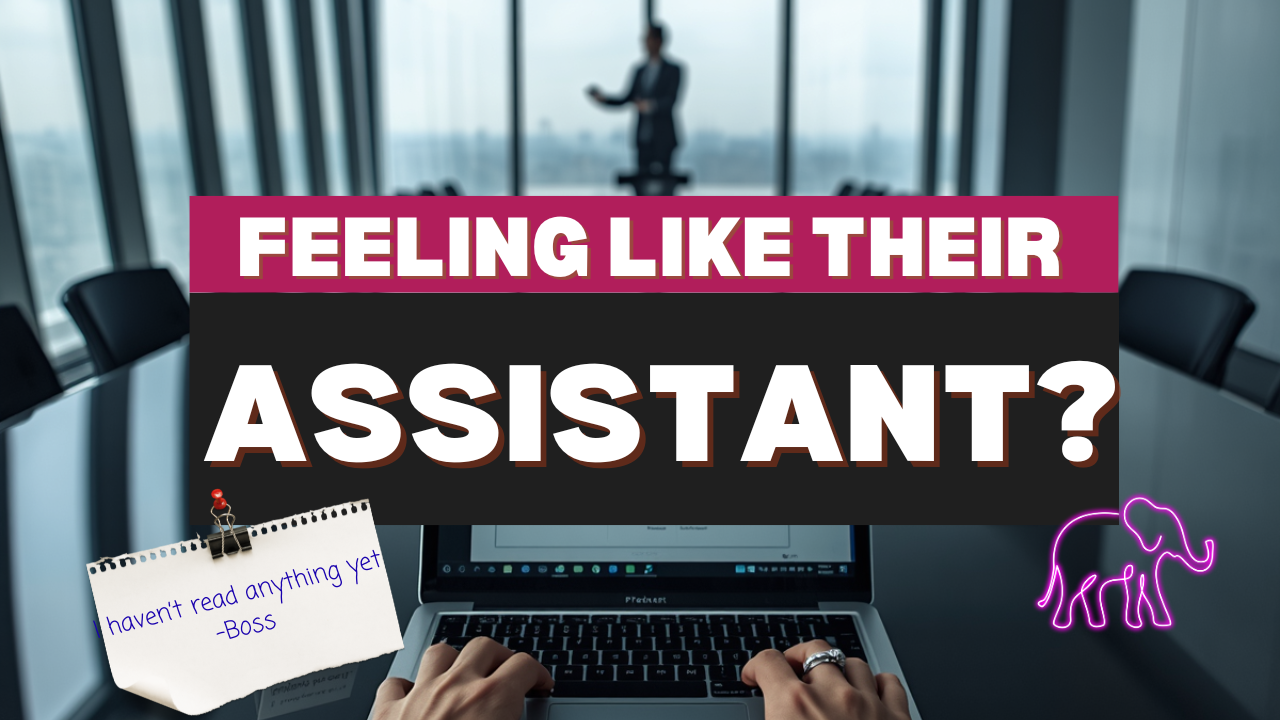
"Managing up is just managing someone who thinks they're leading you."
You sent the deck. You set up the pre-brief. You texted. You called the hour before. You prepared everything. And then they walked into that meeting and whispered:
I haven't read anything you sent me.
You carried the whole meeting on your back. And on the way out the door, they said: you didn't manage up well enough.
This episode is the one you forward to every person who has ever nodded silently while absorbing a wave of feedback that had nothing to do with their actual work performance.
Marissa Green and Susan Page confront the elephant that lives inside almost every organization: the emotionally mature person is often not the one holding the title. And the most expensive, time-draining, and invisible tax on that person is the unpaid second job of managing their leader's ego.
The "Expensive Assistant" Trap
When managing up becomes a survival skill rather than a professional one, it is no longer feedback — it is performance. Marissa puts a name on the exact moment most high performers recognize instantly: the full cycle of preparation, abandoned by the very leader you were preparing, followed by being blamed for the gap they created. She calls it being an expensive assistant.
The real cost isn't the extra hour spent on the pre-brief. The real cost is what that time stole from the actual work. From the strategy. From the team. From the organization's capacity to do the thing it hired you to do.
Control-Based Leadership and What It Actually Costs
Susan and Marissa isolate the deeper driver beneath most managing-up dynamics: a leader for whom control equals value. When a leader's sense of worth inside the organization depends on having every piece of information that lives in your head, your job quietly shifts. You are no longer producing great work. You are manufacturing a constant briefing loop to keep someone else comfortable.
That is not a leadership system. It is a waste — for the organization, for the leader, and most pointedly, for the person doing the labor.
“If your value is tied to duplicating the exact same value proposition that your team individually brings to the organization, that is inefficient. Full stop.”
Reframe: Managing Up Is Just Upward Feedback
One of the most quietly radical moves in this episode is Susan simply asking: what if we stopped calling it managing up? What if organizations treated it as what it actually is — feedback, traveling upward through a hierarchy that is afraid of it?
The sanitizing of the term is part of the problem. Calling upward feedback "managing up" is a protective softener — designed to keep the ego of the person receiving it intact. The more urgent reframe is building a feedback culture where the direction of the feedback doesn't require a separate, careful, exhausting strategy just to be heard.
The Psychological Safety Connection
This is where Marissa names something important: the managing-up problem is not just a performance issue. It is a psychological safety issue. When leaders cannot receive challenge, teams learn to perform compliance. They stop correcting in the room. They stop flagging the wrong turn before it costs the whole project. And the downstream cost of that silence is enormous.
Even leaders who do not care about psychological safety for the right reasons should care about it for one practical one: a team that has to manage your ego is a team that cannot fully do its job.
The Self-Audit: Is This Still Worth It to You?
The back half of this episode turns the lens around. If you are the person doing the invisible emotional labor — the one carrying the meeting, making the silent corrections, managing the temperature of the room so your leader feels confident — at what point do you stop and ask: is this role still serving me?
Marissa frames the two positions most people find themselves in right now. You are either staying in the churn, navigating the system as best you can, or you are the one willing to name what is broken — and do the work to grow through it toward a different kind of power.
Take the Conversation Further
If this episode landed, the S1 E15 Practice Guide: The Emotional Labor Audit is the tactical companion. It gives you the diagnostic, the scripts, and the self-audit framework to name your situation clearly — and decide what to do about it.
Download the S1 E15 Practice Guide: The Emotional Labor Audit
The "Invisible Tax" Diagnostic: 3 checkpoints to identify whether your managing-up load has crossed from professional to exploitative.
The Brave Feedback Scripts: Word-for-word phrasing to deliver upward feedback without the ego-wrapping corporate softeners.
The "Feedback Culture" Canvas: A self-audit worksheet to evaluate whether your organization is wasting your emotional capital.
The Executive Cheat Sheet: Three non-negotiable rules for leaders who want their team to stop managing them and start partnering with them.
“Stop using the softened language of ‘managing up’ to absorb what is actually unpaid emotional labor. If you are a leader, create the conditions where your team doesn’t have to perform compliance just to give you honest feedback. If you are an individual, run the audit. You deserve a room where your work speaks louder than your boss’s ego.”
This is your cue to stop being someone's expensive assistant — and start being the voice that changes the room.
If you can't receive honest feedback from your team, your leadership is just theater.
-
00:00 — The Hook: The anatomy of the full managing-up failure cycle — you prepared everything, they read nothing, and somehow it's still your fault.
02:55 — The Elephant in the Room: When the most emotionally mature person in the room doesn't have the title.
05:57 — The Expensive Assistant: Cataloging the invisible second job that manages the unprepared leader.
09:26 — The Control Driver: Why leaders who tie their worth to information control are burning organizational capacity.
11:39 — The Reframe: Replacing "managing up" with a real feedback culture.
13:09 — The Psychological Safety Link: Why ego-managing is a symptom of a broken safety structure.
17:24 — Reading the Room: How hierarchy fear shows up in real-time on Zoom calls — and what it costs.
21:17 — Decision Overturning: The specific leadership behavior that makes the loop worse.
24:09 — The Breaking Point: Naming the moment when you have to ask — is this still right for me?
28:09 — Scarcity Mindset: Why corporate culture is engineered toward fear, and what brave leadership looks like inside it.
33:30 — The Two Camps: Navigate the system or evolve through it — where do you stand?
-
-